


NOTE: The @WorldBank President was specifically asked a question about the Bank's intervention in Northeast Nigeria: worldbank.org/en/news/speech…

The World Bank today announced close to half-a-billion dollars in grant-based support to help Bangladesh address the needs of Rohingya refugees in areas such as health, education, water and sanitation, disaster risk management, and social protection.
Reflecting the increasingly protracted nature of the Rohingya crisis, the World Bank Board of Directors today approved a $50 million additional grant to an existing Health Sector Support Project in Bangladesh that is the first in a series that could total as much as $480 million.
The health-sector grant includes contributions based on an innovative partnership between the Government of Canada and the International Development Association (IDA), the World Bank’s fund for the poorest countries.
It will help the Rohingya receive maternal, neonatal, infant, child, and adolescent health and nutrition services, as well as reproductive health care and family planning support.
“Bangladesh has shown great leadership in this evolving humanitarian crisis by providing refuge for the Rohingya people. This grant allows the World Bank Group, working in collaboration with the Government of Canada, to support these efforts,” World Bank Group President Jim Yong Kim said.
“We are deeply moved by the suffering of the Rohingya people and stand ready to help them until they can return home in a safe, voluntary, and dignified manner. At the same time, we are also continuing to support the Bangladeshi people and the host communities, who have shown great generosity by welcoming these refugees.”
The healthcare needs of the Rohingya are vast, and their vulnerability to disease outbreaks and the prevalence of child malnutrition are high. According to surveys conducted in the camps, one in every four children is acutely malnourished.

“We are pleased to partner with the World Bank and the Government of Bangladesh in providing additional support for the displaced Rohingya in Bangladesh,”said Marie-Claude Bibeau, Minister of International Development of Canada.
“Through this innovative initiative, for every dollar contributed by Canada, five additional grant dollars will be unlocked in support of much needed health, nutrition and population services for the refugees.”
Seasonal rains, causing flooding and landslides, will have important health impacts, including injuries, exacerbation of water-borne diseases, and reduced access to health services. It is estimated that 200,000 people are at risk of landslides and floods during the monsoon season.
“Bangladesh has sheltered the Rohingya people fleeing from violence in Myanmar because it is the right thing to do for fellow human beings. But their needs are enormous and the world needs to step up support,” said Honorable Minister of Finance, Mr. A.M.A Muhith, Government of Bangladesh.
“The World Bank has been very prompt in supporting us with nearly half-a-billion dollars grant to help the Rohingya people with their safe, voluntary and dignified return to Myanmar. We are committed to addressing the basic needs of these unfortunate refugees.”
The World Bank Group President Jim Yong Kim, along with the United Nations Secretary-General António Guterres, will visit Bangladesh on July 1-2 to assess the severity of the crisis and discuss what more can be done. They will visit the Rohingya settlements in Cox’s Bazar and meet with the Prime Minister, Finance Minister, other senior government officials, and representatives of civil society and other partners.
In addition to health challenges facing the Rohingya, the learning needs of highly vulnerable refugee youth and children are emerging as another priority. Approximately 370,000 children and youth (55 percent of the total displaced Rohingya population) need access to schooling.
An additional grant to the education project, currently under preparation, will provide basic education and psycho-social support to refugee children and youth. The subsequently proposed investments will be in the areas of disaster risk management, water and sanitation, environmental protection and conservation, social protection, urban services, and social cohesion and gender.
Since August last year, more than 700,000 Rohingya have taken shelter from violence in Myanmar in the Cox’s Bazar District in Bangladesh, making it the world’s largest and fastest growing refugee camp, and putting pressure on the environment, existing infrastructure, and social services that were already constrained.
The World Bank funding for Bangladesh to cope with the crisis will include up to $400 million on grant terms to support the Rohingya refugees from the IDA18 Regional Sub-window for Refugees and Host Communities.

President of the World Bank Jim Kim in his bid to making the global market system work for everyone and for the planet, met with David Rubenstein, the co-founder of the Carlyle Group at the Global Private Equity Conference in Washington.
They had a great conversation concerning the World Bank Group's agenda which is focused on bringing private sector investment to developing countries to spur sustainable economic growth and investment in people.
There is a huge opportunity for investors to do good while doing well and to drive the impact we need to meet the rising aspirations of people around the world.

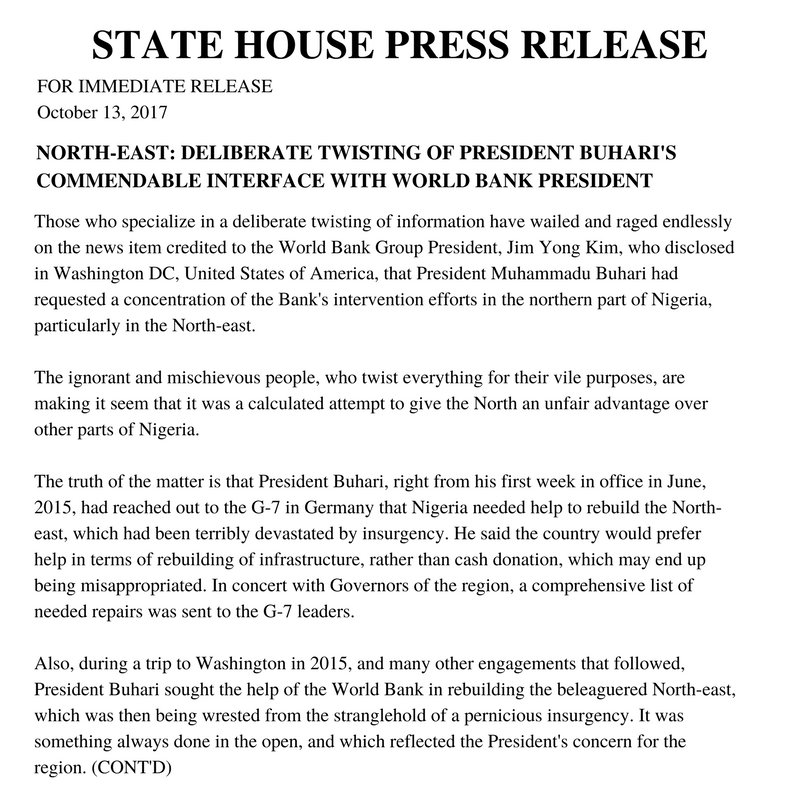
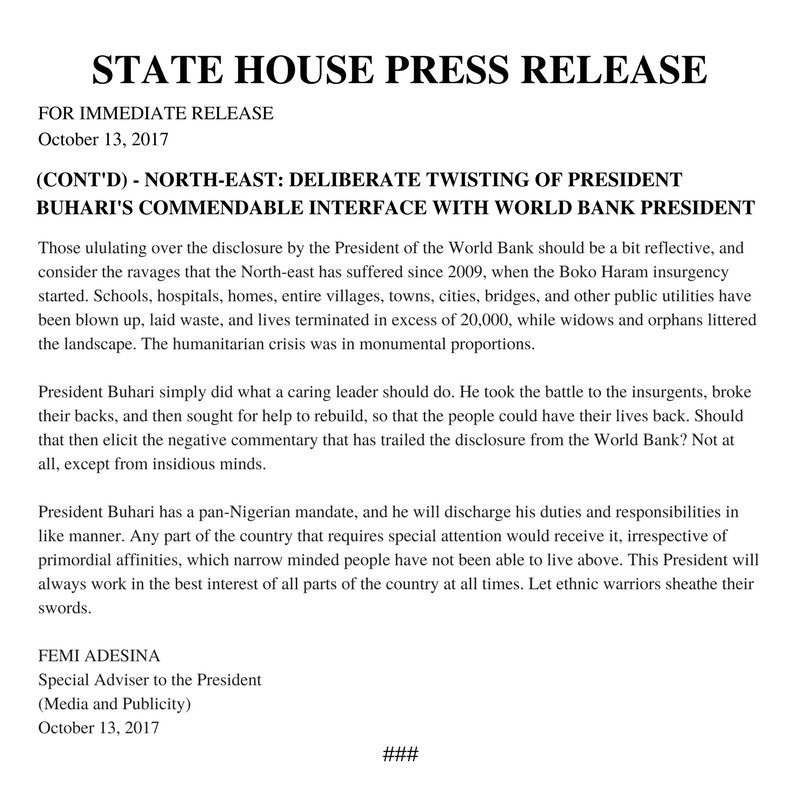
The Presidency has reacted to reports making the rounds that President Buhari asked that the World Bank shifts its “focus to the northern region of Nigeria”.
President Buhari asked that we shift focus to Northern Nigeria – World Bank President Jim Yong Kim
Speaking at the annual meeting of the International Monetary Fund (IMF)-World Bank Group, president of World Bank Group Jim Yong Kim said President Muhammadu Buhari asked that the group shifts focus to Northern Nigeria, saying “the work there has been very difficult”.
He said he advised Buhari that Nigeria has to invest in its people, and in things that will allow the country thrive.
He said:
You know, in my very first meeting with President Buhari he said specifically that he would like us to shift our focus to the northern region of Nigeria and we’ve done that. Now, it has been very difficult. The work there has been very difficult.
I think Nigeria, of course, has suffered from the dropping oil prices. I think things are just now getting better. But the conversation we need to have with Nigeria, I think, is in many ways related to the theme that I brought to the table just this past week, which is investment in human capital. The percentage of the Gross Domestic Product that Nigeria spends on healthcare is less than one percent.”
Despite that, there is so much turbulence in the northern part of the country, and there is the hit that was taken from the drop in the oil prices. Nigeria has to think ahead and invest in its people. Investing in the things that will allow Nigeria to be a thriving, rapidly growing economy in the future is what the country has to focus on right now.
Focusing on the northern part of Nigeria, we hope that as commodity prices stabilize and oil prices come back up, the economy will grow a bit more. But very, very much important is the need to focus on what the drivers of growth in the future will be.
The presidency, reacting to the reports, said that Kim “was specifically asked a question about the Bank’s intervention in Northeast Nigeria.”
The presidency also shared a screenshot from the transcript at the meeting, which showed that a reporter from Nigeria asked Kim “What can you tell us about Nigeria, specifically your intervention in the power sector, and also, what is the World Bank doing to support those ravaged in the northeastern part of Nigeria by the Boko Haram terrorists? Thank you.”
See below:
A statement signed by Buhari’s Special Adviser (Media and Publicity) Femi Adesina to that effect also read:

he World Bank says Nigeria will record an inflow of $22 billion from foreign remittances in 2017 – an increase from $19 billion recorded in 2016.
According to the Migration and Development Brief released by the bank on Tuesday, global remittance flow will recover in 2017 after two consecutive years of decline.
Highlights:
- A statement on the bank’s website read, “Officially recorded remittances to developing countries are expected to grow by 4.8% to $450 billion for 2017. Global remittances, which include flows to high-income countries, are projected to grow by 3.9% to $596 billion.”
- “Among major remittance recipients, India retains its top spot, with remittances expected to total $65 billion this year, followed by China ($61 billion), the Philippines ($33 billion), Mexico (a record $31 billion), and Nigeria ($22 billion).
- “Buoyed by improved economic activity in high-income OECD countries, remittances to Sub-Saharan Africa are projected to grow by a robust 10 percent to $38 billion this year. The region’s major remittance receiving countries, Nigeria, Senegal and Ghana, are all set for growth.
- “The region is also host to a number of countries where remittances account for a significant share of GDP, including Liberia (26%), Comoros (21%), and the Gambia (20%). Remittances will grow by a moderate 3.8% to $39 billion in 2018.”

The World Bank and the Anambra state government have concluded arrangements to contain the gully erosion ravaging the Nkpor flyover and Omagba phase 2 areas of Onitsha North and Idemili North local government areas of the state.
The Executive Secretary of the Anambra State Emergency Management Agency, SEMA, Chief Paul Odenigbo, disclosed this while handing over relief materials worth millions of naira to victims of the gully erosion at Omagba phase 2. Chief Odenigbo, represented by a Director in the Agency, Barrister Chuks Onyejekwe, said the erosion control and containment project would be supervised by NENMAP, a World Bank agency.
He noted that NEWMAP is already assisting the state government to control and contain the menace of gully erosion in some of the over one thousand erosion sites in different parts of the state.
The SEMA boss said the erosion containment at Omagba in Onitsha metropolis would also include reconstruction of Akpugoeze road in the area and what he called: "alternative source of livelihood" for some victims of the erosion menace who might be compelled to relocate to safer places.
In a remark, the member representing Idemili North in the House of Assembly, Chief Tochukwu Mmegbuaneze, expressed gratitude to the Obiano administration for its quick response to the plight of his constituents.
Some residents of the area, through their Secretary, Mr. Arthur Onweluzo, pledged to give absolute support to Governor Willie Obiano's second term bid in the forthcoming gubernatorial election.
The relief materials handed over to victims of the Nkpor flyover/Omagba phase Two erosion menace include; bags of cement, bundles of roofing sheets and nails, bags of rice, mattresses and other beddings as well as buckets among others.
Subscribe to:
Posts
(
Atom
)


