

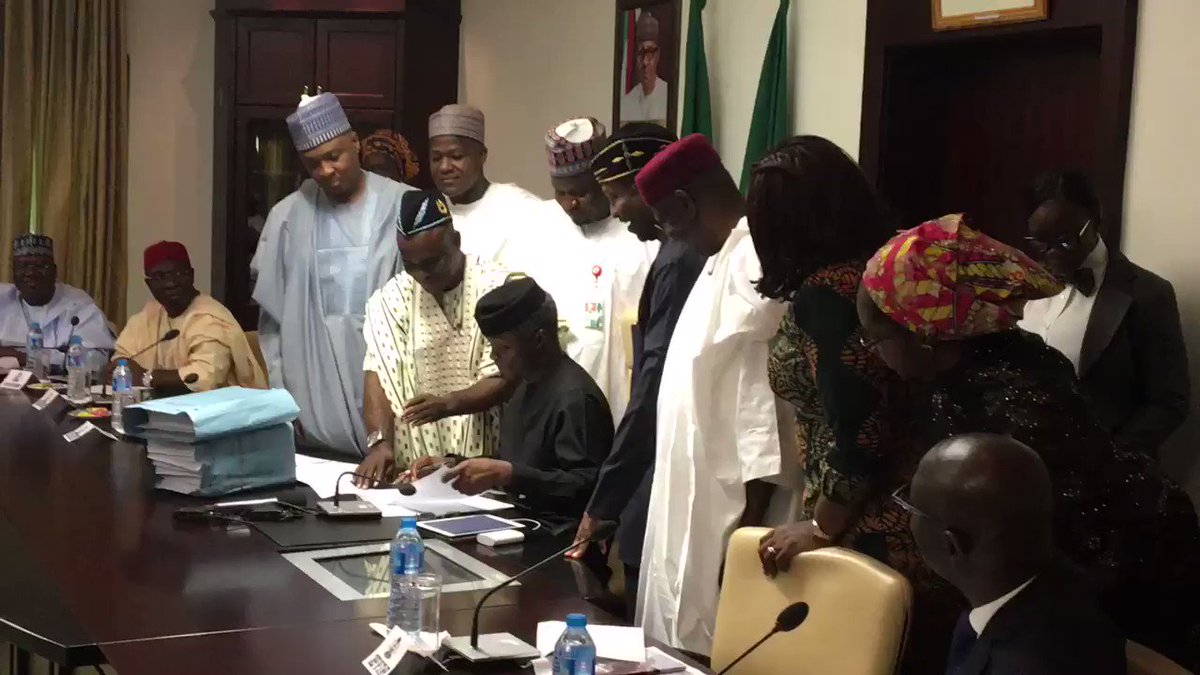

Acting President @ProfOsinbajo assents to the 2017 Budget, in the presence of senior Govt officials from Legislature & Executive #Budget2017

Lets recall that the Acting President of Nigeria Yemi Osinbajo signed 2017 Budget into Law at the State House, Abuja, 12th June 2017.
1. The 2017 Budget Preparation process was a much more efficient process than the 2016 process. There was also less acrimony regarding it, between the Executive and Legislature.
2. The 2017 Budget was collated using — for the first time ever — a web-based application developed by the Budget Office of the Federation (BOF). Instead of the traditional method of hard copy submissions of budget proposals, Ministries, Departments and Agencies were asked to upload their proposals to the new budget preparation portal, resulting in a more efficient and transparent preparation process.
3. More than 4,000 staff of the MDAs were specially trained to use the new application, across multiple locations nationwide. To support the deployment of the budget portal, the Budget Office set up a Helpdesk, accessible by telephone and email, for authorized users.
4. President Buhari presented the 2017 Budget Speech to a Joint Session of the National Assembly on December 14, 2016.
5. The National Assembly passed the Budget on May 11, 2017, five months after it was submitted by President Buhari.
6. The next step, which should have been the signing of the Budget by the Executive, was delayed because of disagreements regarding some alterations the National Assembly made to the submitted document — for example the National Assembly reduced proposed budgets for a number of critical infrastructure projects (the standard gauge railway projects, the Mambilla Power Project, the Second Niger Bridge, the Lagos–Ibadan Expressway etc), and applied the difference to fund some new projects introduced by the legislators.
7. What followed were four weeks of painstaking engagement between Executive and Legislature, to resolve the differences.
8. The conclusion of the matter is that the funding deductions on those critical projects will all be restored during the course of the budget year. The leadership of the National Assembly has assured the Executive that this will be done.
9. The Executive and the National Assembly have reached an agreement to return the Federal Government to a January–December budget calendar, starting from the 2018 budget. To ensure this happens the Executive has committed to submitting the 2018 budget to the National Assembly by October 2017, and on its part the Assembly has committed to passing the budget into law before the end of 2017.
10. Budget Highlights:
a. Total expenditure of N7.44 trillion, comprising N5.08 trillion in revenues and a projected deficit of N2.36 trillion which will largely be financed by borrowing.
b. N2 trillion for capital expenditure (principally infrastructure).
c. More than N500 billion for investments in roads, and power and housing projects
d. N46 billion for Special Economic Zone Projects to be set up in each geopolitical zone.

Acting President Yemi Osinbajo, on June 12, signed the 2017 budget into law. President Muhammadu Buhari should have done the honour. But he’s receiving medical treatment in London.
In a letter addressed to Budget Minister, Udoma Udo Udoma, Buhari said it was in the interest of the nation’s economy for Osinbajo to sign the 2017 Appropriation Bill into law.
President Buhari wrote the letter to Senator Udoma Udo Udoma, according to a statement by Garba Shehu, the senior special assistant to the president on the media and publicity, NAN reported.
President Buhari, who is recuperating in London, said he had received a full briefing on the Appropriation Bill as passed by the National Assembly.
To buttress the unity at the highest level of government, he said he was yielding his signatory authority to Osinbajo.

Acting President of Nigeria Yemi Osinbajo has signed the 2017 Appropriation Bill into law. Osinbajo made the announcement via Twitter on Monday.

The event was attended by leaders of the National Assembly, Senate President Bukola Saraki, House Speaker Yakubu Dogara, as well as members of the Federal Executive Council.
The National Assembly on May 11, passed the 2017 Appropriation Bill, raising the figure from N7.30 trillion presented by President Muhammadu Buhari on December 14, 2016, to N7.44 trillion.
In the approval, Statutory Transfers got N434 billion, N1.8 trillion for Debt Servicing, N177.5 billion for Sinking Fund for Maturity Bonds and N2.99 trillion for Recurrent Non-Debt Expenditure.

Contribution to the Development Fund for Capital Expenditure, exclusive of the capital expenditure in statutory transfers for the year ending December 31, 2017, got N2.2 trillion.
The chamber pegged crude oil production for the budget at 2.2 million barrels per day, with foreign exchange rate of N305 to a dollar.
Tweets from the Nigerian President's official Twitter page (@NGRPresident) wrote;
"At 4.40pm today June 12, 2017, Acting President, Prof. Osinbajo assented to the 2017 Appropriation Bill.
"The 2017 Budget is christened the Budget of Economic Recovery and Growth.
"Osinbajo, on signing #Budget2017: "The bleakness of recession is about to witness the uplifting dawn of abundance."
"I'd like to express appreciation to @nassnigeria for completing the work of the 2017 Appropriations Bill.
"We have reached an agreement with @nassnigeria to submit #Budget2018 by Oct 2017, and have it passed into law by Dec 2017"
Subscribe to:
Posts
(
Atom
)


