


The Ikeji family indeed knows how to love up on each other.... Its said that "Charity Begins At Home"...As Celebrity Blogger and Entrepreneur Aunty Linda Ikeji gifts Sandra her sister a 30million Mercedes Benz GLE 350 just a look alike to that which Laura got.
This is indeed a huge surprise to Sandra Ikeji who had just returned from church after a one week retreat. Funny enough, it's not even her birthday nor was she expecting anything
Congratulations ma on your new Gift.....More Blessings will indeed come your way. Just don't hesitate to surprise others
Check out more photos below
This is indeed a huge surprise to Sandra Ikeji who had just returned from church after a one week retreat. Funny enough, it's not even her birthday nor was she expecting anything
Congratulations ma on your new Gift.....More Blessings will indeed come your way. Just don't hesitate to surprise others
Check out more photos below


Life isn’t about how much horsepower you have, but how you use it. Armed with the 603-hp version of AMG’s twin-turbocharged 4.0-liter V-8 engine, Mercedes-AMG's E63 S falls short of Dodge’s 707-hp Charger SRT Hellcat and Cadillac’s 650-hp CTS-V. (The non-S E63, which we don’t get in the States, makes “just” 563 horses.) And yet thanks to its new nine-speed automatic transmission and 4Matic+ all-wheel drive, the AMG lays down its lesser output far more effectively than either of those rear-drive muscle-machines.
One Mississippi, Two Mississippi, Three . . .
Just 3.0 seconds. That’s all it takes for the E63 to launch itself to 60 mph. Four seconds later, the Mercedes is traveling 100 mph. Those acceleration times are 0.4-second and 0.2-second quicker than the five-pound-heavier Hellcat and far ahead of the 458-pound-lighter CTS-V, neatly summarizing the benefit of all-wheel drive in launching high-horsepower cars from a standstill.
The preposterous list of vehicles that the E63 beats or ties to 60 mph includes Mercedes-AMG’s own GT S sports car, the McLaren 570GT, and the dozen-plus non-Turbo 991.2 Porsche 911 Carreras we’ve tested. Among four-doors, only Tesla’s Model S is quicker to 60—and just barely. BMW’s new 600-hp M5 sedan, now also with all-wheel drive, is a direct competitor that we’ve yet to test—it might come close.

Mercedes-AMG’s launch-control function is invitingly straightforward: Thumb the driving-mode switch to Sport, Sport+, or Race; hold the brake with your left foot; and depress the accelerator until the revs stabilize at 4000 rpm. When your left foot steps off the brake, the E63 rockets forward ahead of a wave of rippling V-8 noise. Our test car’s tailpipe music was enhanced by the $1250 dual-mode AMG Performance exhaust option. Some additional sound also is piped in through the speakers, but it sounds like a live recording of the actual engine, so we’ll give that trickery a pass.
Continue on to felonious speeds, and by 110 mph the E63 is reeled in by the Dodge and its advantageous power-to-weight ratio. After that, the Hellcat nips the E63 by mere tenths all the way up to 170 mph. Both cars are among the rarified few (Lamborghini’s Huracán supercar among them) capable of accelerating past that speed—and braking before running out of road—on the 1.6-mile straightaway where we conduct acceleration and braking evaluations. Our E63 did manage to outawesome the Charger’s 13-mpg fuel economy, averaging a profligate 12 mpg overall during our test.
Hard-Boiled E-class
The rest of the E63’s dynamic repertoire builds nicely on the foundation laid by its less powerful, comparison-test-winning, six-cylinder Mercedes-AMG E43 sibling. The E63’s staggered-width Michelin Pilot Sport 4S performance tires have a 20-millimeter-larger cross section than the E43’s Pirelli P Zero Run Flats, which helped our E63 notch an additional 0.09 g of grip on the skidpad, for a sticky total of 1.01 g.
That same rubber, in combination with the $8950 carbon-ceramic brake option, bolstered our test driver’s confidence in pushing for speed on our straightaway. We noted zero fade after repeated anchor drops, ultimately returning a 155-foot stop from 70 mph

This athleticism is barely concealed on the highway, where the ride is decent and quiet in the suspension’s Comfort mode, and the steering’s well-defined on-center valley and heavy weighting make for relaxed cruising. Even so, everything about the E63 feels drumhead tight, though, a trigger-pull away from twitching into action. (The thin-sidewall performance tires literally are drum-tight, as road impacts slap and twang through to the driver’s ears.) Switching to Sport, Sport+, or Race modes cuts through the genteel veneer, progressively skewing the E63’s ride ever more geological and shoving cocaine up the powertrain’s nose.
Drivers should come prepared to match the car’s reflexes. The new 4Matic+ all-wheel drive can send 100 percent of engine torque to the rear axle. Mid-corner throttle applications provoke the rear-biased 4Matic+ system and electronically locking rear differential to initiate gentle, controllable drifts. Bigger throttle openings net larger effects. And as we discovered at this year’s Lightning Lap track test at Virginia International Raceway, where the E63 posted the fastest-ever lap time for a sedan, the chassis enthusiastically rotates off-throttle, too.

Sideways Action
Should these handling behaviors fail to result in a satisfactory rate of yaw or sufficient consumption of the rear Michelins, there’s also the E63’s Drift mode. It declutches the front axle from the transfer case, sending torque only to the rear wheels. Compared with activating launch control, initiating this process is considerably less simple: First, select Race mode, then switch the transmission to manual shifting mode.
Next, press and hold the stability-control button until it switches off, pull back on both shift paddles until an “Are you sure you want to do this?” message appears in the gauge cluster, then pull back once on the right-hand paddle. Not-so-presto, you’re ready to make bad decisions with 603 horsepower, two driven wheels, and zero stability-control intervention.
Spared from predicting how much help you’ll receive from the front axle, rubber-coating pavement is both easier and more controllable in Drift mode. You will get no help and like it, and like it we did. You’ll also experience the new nine-speed automatic’s near-instantaneous response to manual gear selections. When left to shift automatically, the nine-speed’s gear selection is impeccable, and its tall top gear keeps revs low and quiet on the freeway.
Although it still uses a clutch pack in place of a torque converter as did the seven-speed it replaces (allowing for brutal launch-control starts), the new transmission’s low-speed behavior is vastly improved and nearly torque-converter smooth.

As it did with previous E63s, Mercedes-AMG wraps the new model’s rage in discreet and upscale clothing. It’s the automotive equivalent of Daniel Craig’s James Bond, an anger-management head case in a tuxedo. Aside from its burbling quad exhaust pipes, wide-mouth front air intakes, and our test car’s $1700 black-painted forged-aluminum wheels, the E63 looks like any other E-class or—depending on the viewer’s distance—any Mercedes C- or S-class. Until it kicks you in the face.
There is the matter of the immoderate price. The AMG is $36,305 dearer than a Dodge Charger Hellcat and a $16,905 leap above a Cadillac CTS-V. Our test car’s additional $29,935 in extras elevated the total cost to $135,330. Call it justified, though, as this counts as downright cheap for a machine capable of reaching 60 mph so quickly (not to mention doing other things well). Alternatives include the $135,000 Tesla Model S P100D and the $162,850 Porsche 911 Turbo. Price notwithstanding, if you could own just one vehicle, this would be a good choice. Plus, there’s a wagon version.
Specifications >
VEHICLE TYPE: front-engine, rear-/all-wheel-drive, 5-passenger, 4-door sedan
PRICE AS TESTED: $135,330 (base price: $105,395)
ENGINE TYPE: twin-turbocharged and intercooled DOHC 32-valve V-8, aluminum block and heads, direct fuel injection
Displacement: 243 cu in, 3982 cc
Power: 603 hp @ 6500 rpm
Torque: 627 lb-ft @ 2500 rpm
TRANSMISSION: 9-speed automatic with manual shifting mode
DIMENSIONS:
Wheelbase: 115.7 in
Length: 196.4 in
Width: 75.1 in Height: 56.6 in
Passenger volume: 98 cu ft
Trunk volume: 13 cu ft
Curb weight: 4587 lb
C/D TEST RESULTS:
Zero to 60 mph: 3.0 sec
Zero to 100 mph: 7.0 sec
Zero to 130 mph: 11.9 sec
Zero to 150 mph: 16.6 sec
Zero to 170 mph: 23.3 sec
Rolling start, 5–60 mph: 3.9 sec
Top gear, 30–50 mph: 2.3 sec
Top gear, 50–70 mph: 2.7 sec
Standing ¼-mile: 11.1 sec @ 126 mph
Top speed (governor limited, mfr's claim): 186 mph
Braking, 70–0 mph: 155 ft
Roadholding, 300-ft-dia skidpad: 1.01 g
C/D FUEL ECONOMY:
Observed: 12 mpg
75-mph highway driving: 22 mpg
Highway range: 460 mi
EPA FUEL ECONOMY:
Combined/city/highway: 18/15/22 mpg

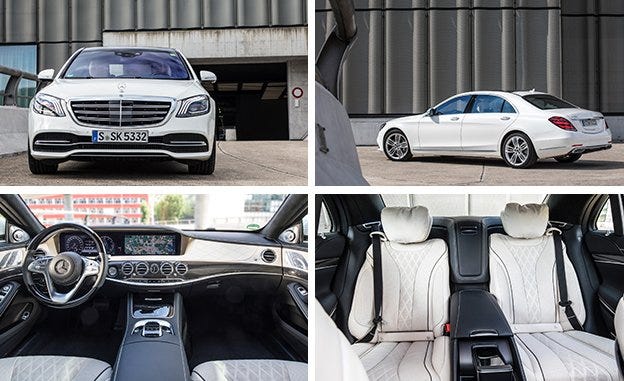
For 2018, the S-class sees a mid-cycle update that brings powertrain changes, interior and exterior design tweaks, and, most significantly, enhanced semi-autonomous driving functions.
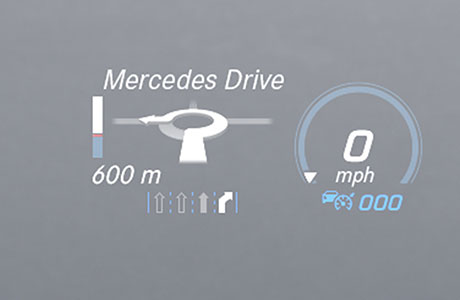
In the new 2018 S-class, the cruise control automatically adjusts its speed for curves, intersections, changes in the speed limit, and toll plazas. (Its knowledge of the terrain is based on GPS data.) This goes a step beyond the functionality previously offered in the mid-size E-class. The net effect is that one can use cruise control—and its attendant steering-assist function—much more often on secondary roads and not just on highways.
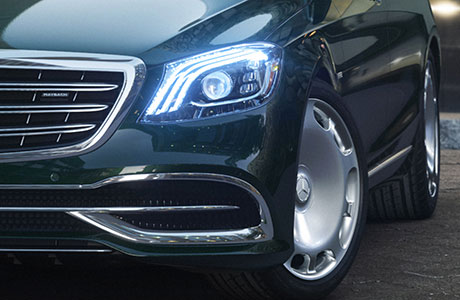
This could be the biggest development in cruise control since adaptive cruise allowed drivers to use the feature in heavy traffic, provided that drivers get comfortable with it. It is a little harder to trust than simple adaptive cruise control. With the car in its default Comfort driving mode, the cruise control will slow considerably for curves—more so than you might on your own—before quickly accelerating back to the set speed. In Sport or Sport+, however, it doesn’t slow as much and carries more momentum through corners.
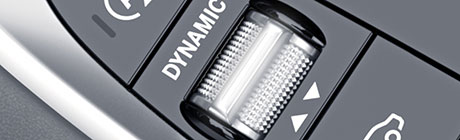
That aspect works fine, but what’s somewhat disconcerting is learning to trust the car to slow on its own when approaching intersections, because the driver must be ready to brake for oncoming traffic at a yield or to brake for a stop at a stop sign.
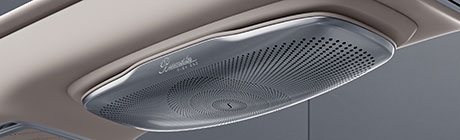
If there’s no oncoming traffic at a yield and no braking is required, the driver can stay off the brakes and let the car do it all; if one does have to brake at a yield or for a stop, the driver afterward needs to hit the resume button to reactivate cruise control.
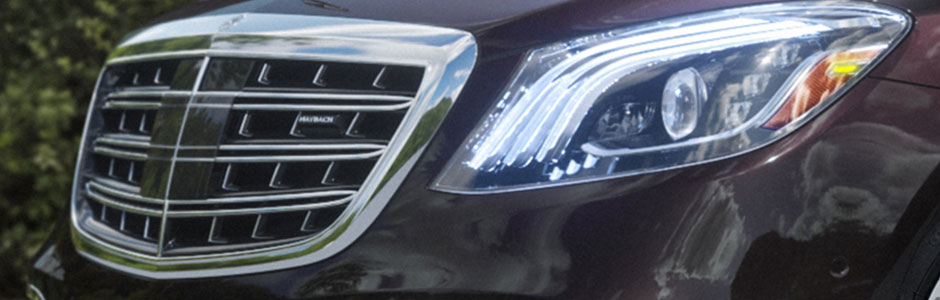
(The resume and other cruise-control switches have moved to the left spoke of the steering wheel; M-B’s stalk-mounted controls are no more.) In addition to slowing for curves or intersections on the current road, if the driver indicates a turn onto a side street or into a parking lot, the car again will automatically slow for it.
Another major enhancement over last year’s S-class is that the semi-autonomous steering now can perform a lane change. The driver activates the turn signal, and the steering assist will make the lane change, provided the adjacent lane is clear.
If not, the car will cancel the turn signal and wait to switch lanes. When it’s clear (within 10 seconds or so), the system will automatically reactivate the turn signal and steer into the adjacent lane; the instrument cluster indicates what’s happening. Autonomous lane changing works only on multilane roads; it will not execute a pass on a two-lane road.
Engines of Change
Other changes to the S-class are more notable when a human is in control, with the biggest found under the hood. A new base-model S450 employs a V-6 engine making 362 horsepower from 3.0 liters and a pair of turbochargers.

The mainstay S550 becomes the S560—resurrecting a longtime S-class model number—as its twin-turbo V-8 increases in output even as it decreases in displacement. Its previous 449-hp 4.7-liter V-8 is supplanted by a 4.0-liter good for 463 horsepower and 516 lb-ft of torque.
The AMG versions retain their S63 and S65 model names. The eight-cylinder S63 downsizes its V-8 from 5.5 liters to the new 4.0-liter shared with the S560. AMG, however, manages to extract 603 horsepower and 664 lb-ft from those four liters, a gain of 26 horsepower over the old 5.5-liter engine (torque is unchanged).
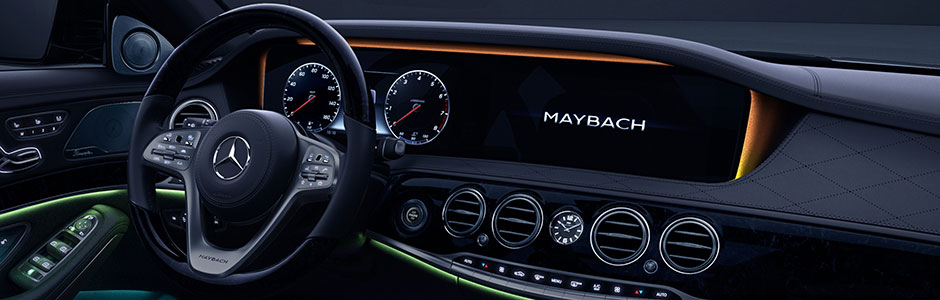
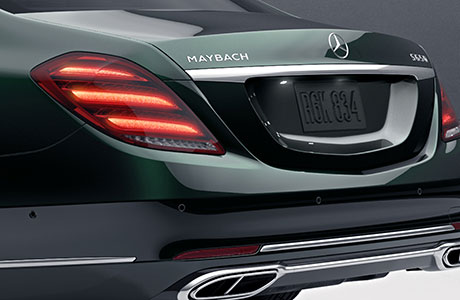
The S65 retains its V-12, which evidently has plateaued at 621 horsepower and 738 lb-ft. That V-12 also appears in the S650 Maybach. Not yet for our market is a new inline-six engine with an electric supercharger along with a conventional turbo, an integrated 48-volt starter/alternator, and direct-drive accessories. (There also will be a diesel inline-six that we’ll probably never see in America.)
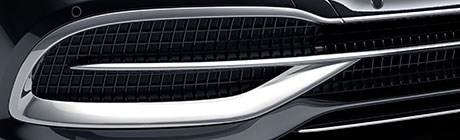
We drove the S560 and the S63, which arrive on our shores this fall. Despite not getting a new model designation, the S63 has more mechanical changes. In addition to the new engine, it trades its seven-speed automatic transmission for a nine-speed unit. Its standard all-wheel-drive system, 4MATIC+, offers a variable front-to-rear split. (The S560 retains the fixed, rear-biased 4MATIC system, but it’s optional.)
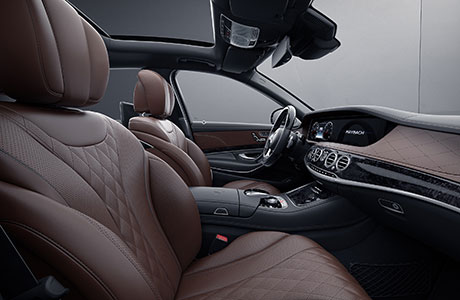
Trundling through town, the S63’s new transmission never betrays its lack of a torque converter. The nine-speed, which is coupled to the engine with a clutch pack, is smooth and well mannered. Pull out to pass in the S63, and it’s like getting punted from behind.
The gearbox instantaneously drops a few gears, and the engine’s forceful wave of torque rockets you ahead. In Sport and Sport+ modes, the driver doesn’t have to dig as deeply into the accelerator travel to get a downshift or two, which seems about right. So, too, is the measured, progressive throttle response, never mind that this is a relatively small engine making big power thanks to two turbos.
The S560 uses a nine-speed automatic, too, but this one has a conventional torque converter. Its downshifts in response to a mashed accelerator are just fractionally less immediate than the S63’s, and the resulting rush of acceleration is considerably less frenetic.
Mercedes puts the S560’s zero-to-60-mph time at 4.5 seconds and the S63’s at 3.4. When it comes time to scrub off speed, the big brakes are easy to modulate. Should you fail to use them, the automated emergency braking system now can avoid a collision—with another car or a pedestrian—at higher speeds, and if the driver attempts to swerve around an obstacle, the steering can assist an evasive maneuver.
Aside from the option of a “curve-tilting function” on the S560 (the Magic Body Control active suspension adjusts to lean into corners; it’s available with rear-drive only), there’s not much new in the way the big Benz rides and handles. Both variants have nicely sorted driving modes, without jarring steps from one to the other (Comfort, Sport, Sport+, and Individual in the S63; the S560 trades Sport+ for Eco mode).

The creamy yet precise steering isn’t overboosted even at low speeds in Comfort, and it seamlessly builds effort if you toggle to a sportier setting. Similarly, the chassis that is compliant in Comfort firms up somewhat in Sport but doesn’t get flinty even in the S63’s Sport+. This is a big, heavy car, however, and even in the AMG in its firmest setting, one is keenly aware of that mass when diving into tight corners. The S-class is supremely capable—particularly the S63—but you wouldn’t call it playful.

Screen Gems
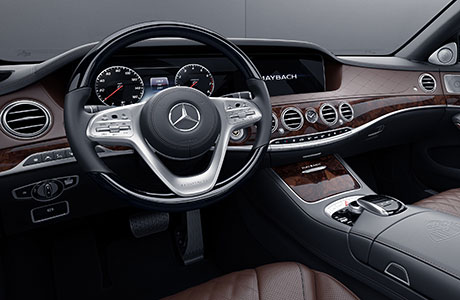
If it’s amusement you’re looking for, you might find it in the wonderland that is the Benz’s widescreen digital dashboard display. The previous pair of 12.3-inch TFT screens are now housed together to appear as a single unit. The center screen’s functions are navigated via the familiar COMAND console-mounted wheel and touchpad or via a tiny touch-sensitive nub on the right spoke of the steering wheel.

You swipe across it or up or down with your thumb, then press it to select—which sounds fussy but actually is pretty easy to use. A similar nub on the left side controls what is displayed in the virtual gauge cluster, which can be set up in three different formats: Sporty, Classic, and Progressive.
Some new discoveries: The S63 has a Track Pace menu in the center screen that can record lap times; a Drag Race page can measure acceleration, quarter-mile times, and braking distances. For just such occasions, Mercedes has made the S63’s Race Start function easier to access: Mash the brake pedal with your left foot while flooring the accelerator with your right; use the shift paddles to increase or decrease the engine revs before releasing the brake.

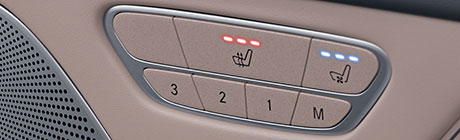
An Energizing Comfort menu purports to create an interior ambiance via audio, lighting, seat massaging, and fragrance. The choices are Refresh, Vitality, Joy, Well Being, and Training. Our drive partner at the media event vetoed Joy, so we tried Well Being.

But that fired up the seat heaters—not ideal on a summer day—and the fragrance was overpowering. We switched to Vitality but hated the music (the system also can pull from your own music collection, provided the beats per minute are appropriate). We completed the rest of our drive without the benefit of Energizing Comfort.

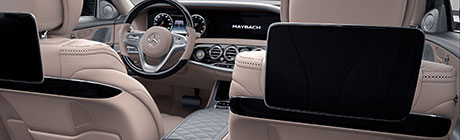
Cast a glance away from the screens and the cabin is largely the same, rich environment we know now, with the main changes being a switch to a three-spoke steering wheel (in the S63 it gets a squared-off rim wrapped in leather and microsuede) and a new standard inductive charging pad on the center console (and an optional second one in the rear).

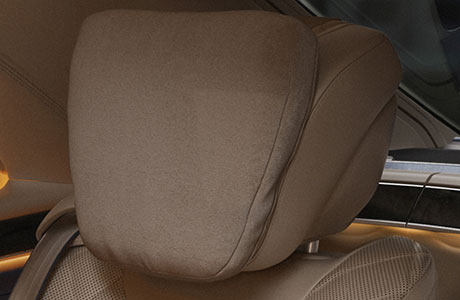
Both the S560 and S63 we drove were dressed up with nappa leather interiors from Benz’s Exclusive collection, featuring a two-tone color scheme, perforated leather in a diamond pattern, and carbon-fiber trim with brushed-metal accents.
No Greyhound ever looked like this inside.

Nor was it as comfortable—even without a snoring vagrant in the next seat. But the 2018 S-class does take another step down the path of turning drivers into passengers. It’s just doing so at the far opposite end of the socioeconomic scale.
Subscribe to:
Posts
(
Atom
)


