


Speaker of the House of Representatives, Yakubu Dogara, has stated that the National Assembly will do its best to ensure whistle-blowers legislation sees the light of the day.
Dogara said this must be achieved not just to protect the whistle blower but also to prevent abuse of the policy.
He said the bill becoming a law will break the jinx that has bedeviled “this piece of legislation since it was first introduced into the National Assembly in 2008”
Dogra spoke on Tuesday in his address at a workshop on Whistle Blower’s Protection Bill for leaders of Civil Society Organizations (CSOs) and Members of the House Committee on Financial Crimes.
His speech reads…
“On behalf of the leadership and members of the House of Representatives, I sincerely welcome you and extend to you the brotherly solidarity of the House.
The consequences of corruption are greater than just the diversion of resources, profound as this is.
Corruption destroys societies and contributes to deficit trust and confidence in governance. According to Corruption Watch, a non-profit organization, ‘Corruption affects us all. It threatens sustainable economic development, ethical values and justice; it destabilizes our society and endangers the rule of law.
It undermines the institutions and values of our democracy. But because public policies and public resources are largely beneficial to the poor and the vulnerable, it is they who suffer the harmful effects of corruption most grievously.”
The burden of corruption in Nigeria is a peculiar one that inhibits our economic and social development. In order to fight this scourge and ensure a just and egalitarian society, the relationship between increased availability of information in the public domain, accountability and protection of anyone who exposes alleged wrongdoing cannot be overemphasized.
Disclosure of information for increased transparency is a necessary condition for accountability. The enactment of Whistle Blowers Protection law as a vehicle for the investigation of alleged corruption and misuse of power by public servants or their private collaborators and to provide adequate safeguards against victimization of the person making such complaint is therefore, an essential element of the war against corruption.
It is important to note that Nigeria does not currently have a law to protect whistle blowers; rather what we have is the Federal Ministry of Finance’s whistle blowing programme which is designed to encourage anyone with information about a violation of financial regulations to report.
Although Federal Ministry of Finance (FMF) Whistle-blowing Programme has led to the recovery of a lot of public funds hidden in various places, including markets, private properties and other ridiculous places, it is not yet backed by an appropriate legal framework.
According to the Ministry, a whistleblower who provides the Government with information that directly leads to the voluntary return of stolen/concealed public funds/assets may be entitled to between 2.5%-5.0% of the amount recovered.
This policy, because it is not law, is subject of administrative review from time to time. A law is therefore required not just to protect the whistle blower but also to prevent abuse of the policy. A policy may not be legally enforceable. In Fed Military Govt v Sani (N0.1) (1989) the Court of Appeal held that: “the policy of any government which has not received the force of law cannot be the basis for punitive measure.”
Even though, the scope of the policy is very wide and covers such critical areas as Public Procurement Act and other extant laws, Mismanagement or misappropriation of public funds and assets, Information on stolen public funds, Information on concealed public funds, Financial malpractice or fraud, Theft, Collecting/soliciting bribes, Corruption, Diversion of revenues and so on, the policy is not enough to provide adequate safeguards or protection against victimization of the person making such complaint.
Many countries have enacted WhistleBlowers laws to protect whistleblowers. The origins of Whistleblowing legislation can be traced to the United States as early as 1863 with the enactment by Congress of the False Claims Act. By 1989, the Whistleblower Protection Act was passed and amended in 2007. It is now called the Whistleblower Protection Enhancement Act of 2007. Also, the United Kingdom passed the Public Interest Disclosure Act (PIDA) in 1999. These Acts offers protections for whistleblowers.
In fact, Article 33 of the United Nations Convention against Corruption (UNCAC), enjoins UNCAC signatory countries to incorporate in their domestic legislation provisions protecting whistleblower witnesses and their families from any unwarranted treatment. It is instructive that Nigeria ratified this convention on 14 December 2004. Although there is no record of legislative domestication of the Convention, the current effort in putting a legislation in place should be regarded as complying with the UN Convention.
Although the Whistle-Blower’s Protection Bill is still before the National Assembly for consideration, the Freedom of Information Act (2011) has some provisions under which whistle-blowers can be offered some form of legal protection.
In the House of Representatives, there is recognition of the frontline role of lawmakers in preventing and exposing corruption as well as providing adequate protection for whistle blowers. We recognize that the Parliament, more than the Executive, has the duty and responsibility to expose corruption, inefficiency and waste within its legislative competence.
We have demonstrated leadership by declaring in our legislative agenda that our people must be at the centre of our activities and we have subjected ourselves as well as our legislative processes to the rule of law.
The House has also recognized that the enactment of the Whistle Blower’s law is one of the first important steps towards establishing and fostering the culture of zero-tolerance to various forms of malpractices including corruption in both public and private sectors.
We are also aware that the protection availed to the persons reporting misconduct in Nigeria and the established mechanisms for reporting wrongdoing must to be set within the broader context of internationally recognized principles and best practices.
To this end, we shall continue to promote citizenship participation in our legislative activities and pass the Whistle Blower’s Bill as a panacea for curbing corruption in Nigeria and promote accountability in governance.
In the words of Barack Obama, former President of USA: “Often the best source of information about waste, fraud, and abuse in government is an existing government employee committed to public integrity and willing to speak out. Such acts of courage and patriotism, which can sometimes save lives and often save taxpayer dollars, should be encouraged rather than stifled. We need to empower federal employees as watchdogs of wrongdoing and partners in performance.”
”I want to assure you of the continued support of the House of Representatives in your quest to promote evaluation and exchange of ideas, coordination and peer-learning in the fight against corruption. A robust framework on Whistle Blower’s law will no doubt enhance quick and seamless recovery, forfeiture, and confiscation of property in respect of anti-corruption offences.”

The Economic and Financial Crimes Commission, EFCC, on Tuesday arraigned the duo of Buhari Fannami and Ba-Kura Abdullahi on two separate one count charge before Justice M. T Salihu of the Federal High Court Maiduguri, for allegedly giving false information to the agency under the whistle blowing policy.
Mr. Fannamit had misled the EFCC with the information about illegally acquired monies purportedly buried at the residence of one Ba’a Lawan but the information turned out to be false after the execution of a search warrant.
The charge reads,
“That you, Buhari Fannami on or about the 8th day of May, 2017 at Maiduguri, Borno State, within the jurisdiction of this Honourable Court, did make statement to Officers of the Economic and Financial Crimes Commission under the Whistle Blowing policy to the effect that large sums of money being the proceeds of crime were buried in the residence Ba’a Lawan at Pompomari Layout along Pompomari Bypass, Maiduguri which information/statement you knew to be false and thereby committed an offence contrary to and punishable under sections 39 (2) (a) and 39 (2) (b) of the Economic and Financial Crimes Commission (Establishment) Act 2004 respectively”.
The accused person pleaded not guilty to the charge.
The counsel to the prosecution, Alkassim Ja’afarn asked for a trial date and prayed the court to remand the accused person in the prison custody pending trial.

On his part, Ba-Kura Abdullahi also gave false information to the effect that large sum of money in naira and foreign currencies were buried in the residence of Ba’a Lawan.
Justice Salihu adjourned the matter to June 7 and 8, 2017 for hearing and trial and also ordered the accused to be remanded in the prison custody.

The Acting Chairman, Economic and Financial Crimes Commission (EFCC), Ibrahim Magu, on Thursday disclosed that the introduction of the whistleblower policy by the Federal Government has led to the recovery of about N17 billion by the Commission.
Magu gave this hint while presenting a paper titled “Before Corruption Kills Nigeria,” at the 62nd Award Night of the Nigeria Union of Journalists (NUJ), held at the Ladi Kwali Hall, Sheraton Hotels, Abuja.
In the paper, which was presented on his behalf by Dr. A. Bello, Magu said,
“apart from several other recoveries running into several billions of naira, the recent whistleblower policy, has led to the recovery of N521,815,000, $53,272,747, £122,890, and €547,730 by the EFCC.”
The EFCC boss, while reiterating the Commission’s commitment to combating corruption called on the media to support the ongoing fight against corruption as that was the only way the battle can be won.
“The EFCC is committed to pursuing its statutory mandate and to rescue the Nigerian state and its people from being killed by corruption. We call on the Media and well meaning Nigerians to join us in this crusade. With the government and people of Nigeria behind the EFCC, we shall surely be victorious,” he said.
Magu also revealed that the EFCC recorded 62 convictions in the first quarter of the year.
In his remarks, the National President, NUJ, Abdulwaheed Odusile, pledged the Union’s support for the EFCC and commended the Commission for its committed efforts in combating corruption of all manners in Nigeria.
He urged the agency to continue carrying out its operation without fear or favour.
“While we commend the EFCC for its efforts in fighting economic crimes and corruption, we urge it to be diligent and painstaking in its assignment, and continue to operate without fear or favour. The media will continue to support their efforts in this regard”, Odusile pledged.
The NUJ president also condemned the rejection of Magu as the substantive chairman of the EFCC by the Senate and called for synergy between the legislature and the executive in the interest of the nation.
“We condemn the undue politicization of the confirmation of the appointment of Ibrahim Magu as chairman of the EFCC by the National Assembly.
We call on the executive and the legislature to work together in the interest of the Nigeria people. The cat and mouse game in their relationship is adversely affecting the state of the nation and the welfare of the people,” Odusile said.

The National Security Adviser, Babagana Munguno, has begun work on a template for the discovery and recovery of illegal weapons through a reward system.
Garba Shehu, the Senior Special Assistant to the President on Media and Publicity, confirmed this development in a statement issued in Abuja on Sunday.
According to the presidential spokesperson, the Office of National Security Adviser, ONSA, is adopting the whistle-blowing approach so as to eradicate mass shooting incidents and remove the harassment of law abiding citizens by holders of illegal weapons.
He said the proposed adoption of the whistle-blowing policy on illegal weapons by the Federal Government followed the success of the policy in the recovery of huge amount of questionable and stolen funds by the Economic and Financial Crimes Commission, EFCC.
Mr. Shehu, therefore, said the presidency had started drawing up the rules of a whistle-blower mechanism to throw a spotlight on the regime of gun ownership and control as a bold move to prevent and eradicate illegal ownership of small arms and light weapons in the country.
He said that this would be a sort of searchlight on weapons ownership in the country, adding that the aim was to disarm communities especially those with proclivity to violence.
“In the last few days, we had discussed the efforts the administration is making to strengthen the whistle-blower mechanism in the Ministry of Finance, which to date has proved to be very effective in bringing the attention of the government to stolen assets and unexplained wealth.
“The ONSA initiative may be an independent line of inquiry or in active collaboration with what the government is doing in Finance. This will be a sort of searchlight on weapons ownership in the country.
“Whatever form or shape it takes, the administration wants to take a tough line to curtail the large number of illegal weapons in circulation used in intra and inter-communal conflicts,’’ he said.
Mr. Shehu disclosed that the ONSA had already inaugurated a committee saddled with the responsibility of the recovery of small arms and light weapons in the country
The News Agency of Nigeria reports that whistle-blowing policy, which has been approved by the Federal Executive Council, is meant to expose fraud and other related crimes in both the public and the private sectors.
The policy was devised by the Ministry of Finance aimed at encouraging anyone with information about a violation, misconduct or improper activity that impacts negatively on Nigerians and government to report it.
“If there is a voluntary return of stolen or concealed public funds or assets on the account of the information provided, the whistle blower may be entitled to anywhere between 2.5 per cent (minimum) and 5.0 per cent (maximum) of the total amount recovered,” Minister of finance Kemi Adeosun said.
The policy has recorded appreciable success as it has led to the discovery of billions of Naira in the last few months since it started.

The Presidency has commenced efforts to strengthen the mechanism of the Whistle blower policy following breakthroughs in the war against corruption and unaccounted wealth, an official has said.
The Senior Special Assistant to the President on Media and Publicity, Garba Shehu, confirmed this development to State House correspondents on Wednesday in Abuja.
He noted that the enthusiastic response of Nigerians to the whistle blower policy had boosted the tempo of the anti-corruption crusade of the Buhari administration.
According to him, the government is considering ways of enhancing the structural capacity of the whistle blower mechanism.
“The government is considering empowering the mechanism by either bringing it under the Presidential Advisory Committee Against Corruption, PACAC or some other body to imbue the process with a strategic national purpose.
“In a word, government thinks that the whistle blower mechanism is too important to be left without a strategic, national direction,’’ he said.
Mr. Shehu commended the zeal and patriotism of Nigerians for responding positively to the whistle blower incentive policy, which was intended to expose hidden looted funds.
According to the presidential aide, no public policy can succeed or go far enough without public support and participation.
“When the citizens realise they are victims of corruption, they may feel encouraged to join the efforts to expose looted funds,’’ her added.
He explained that the huge and incredible amounts of looted funds being recovered by EFCC and the whistle blower efforts
“is a revelation about the mindless, callous and reckless scale on which Nigeria had been robbed by unpatriotic and egregiously selfish public officials.”
He said the election of President Buhari in 2015 was a divine intervention in response to the desperate cries of Nigerians for urgent change.
The presidential spokesman maintained that stealing by officials under a democratic government at the expense of people’s welfare “is worst betrayal of voters’ mandate’’.
According to him, government is getting suggestions to bring the issue of illegal weapons in the hand of citizens that are being used to fuel intra and inter-communal violence under the purview whistle blower policy.
“Yes, it is true; the presidency has received suggestions that call for the whistle blower policy to be extended to the possession of illegal weapons by powerful individuals in the country.
“The government will look at all that and make a pronouncement.
“Nigerians would be encouraged to expose the presence of illegal weapons in the homes of powerful politicians and other public figures, who may use those deadly arms for sinister political agenda.
“Those patriotic Nigerians exposing looted funds deserve all the encouragement and protection to sustain their enthusiasm, with a view to encouraging more citizens to participate in this major aspect of the anti-corruption crusade,” he said.
Mr. Shehu assured that the Buhari administration would ensure judicious use of all recovered funds and commended Nigerians for their support
Source
NAN

A former president, Goodluck Jonathan, Governor of the Central Bank of Nigeria, Godwin Emefiele; and anti-corruption chief, Ibrahim Magu are amongst some high-profile personalities that are expected to be questioned by a presidential panel investigating the mysteries surrounding the over N13 billion recovered from an apartment in Lagos last Wednesday.
The panel will also question the suspended Director-General of the National Intelligence Agency, NIA, Ayodele Oke, and his predecessor, Olaniyi Oladeji.
The owner of the building where the money was found and the EFCC official who led the operation will also be questioned by the three-man panel, which was convened on Wednesday.
The National Security Adviser, Babagana Monguno, who is also a member of the investigating committee is also expected to brief the committee on what he knows following reports that Mr. Oke briefed him on the NIA operation prior to the discovery of the money.
President Muhammadu Buhari named Vice President Yemi Osinbajo to lead the committee, with Attorney General Abubakar Malami and Mr. Monguno being the remaining two members, the presidency said in a statement.
The constitution of the panel came as the presidency announced the immediate suspension of the Secretary to the Government of the Federation, Babachir Lawal, and Mr. Oke for their respective roles in the grass cutting scandal and the over N13 billion recovered in Lagos respectively.
“The president also ordered a full-scale investigation into the discovery of large amounts of foreign and local currencies by the Economic and Financial Crimes Commission, EFCC, in a residential apartment at Osborne Towers, Ikoyi, Lagos, over which the National Intelligence Agency, NIA, has made a claim,” presidential spokesperson, Femi Adesina, said Wednesday.
Mr. Adesina’s statement appears to indicate that the presidency has already accepted the NIA’s argument that the money belongs to it.
The investigative panel was tasked to unravel the
“circumstances in which the NIA came into possession of the funds, how and by whose or which authority the funds were made available to the NIA, and to establish whether or not there has been a breach of the law or security procedure in obtaining custody and use of the funds,” Mr. Adesina said.

In a separate probe, the same committee is also to look into the allegations against Mr. Lawal in the grass cutting scandal.
THE IKOYI RECOVERY
Operatives of the EFCC, acting on a tip-off on April 12, said they found $43,449,947, £27,800 and N23,218,000 hidden inside an apartment at Osborne Towers, Ikoyi.
The funds were valued at over N13 billion based on prevailing exchange rate set by the Central Bank of Nigeria.
But the development, which could have been another success in the ongoing campaign against graft, became problematic for the Buhari administration following conflicting reports about the ownership of the money.

A day after news of the recovery gripped the country, the EFCC approached the Federal High Court, FHC, to secure a forfeiture order.
Muslim Hassan, a judge at the Lagos Division of the FHC, granted the anti-graft agency’s request and gave any potential claimant until May 5, else the entire N13 billion would be permanently forfeited to the Nigerian government.
On April 14, Mr. Oke told newsmen the NIA concealed the money in the apartment for undisclosed operations the foreign intelligence office was conducting.
Our sources said Mr. Oke had approached Mr. Magu to order EFCC operatives who broke into the apartment to back down while the operation was still underway, but the EFCC boss declined his pleas.
But the security chief would not comment on the purpose of the fund, telling this newspaper: “You don’t expect me to tell you that.”
On April 15, Governor Nyesom Wike said the money belonged to Rivers State, having allegedly been plundered by his predecessor, Rotimi Amaechi.
“We have facts to prove that the said money belongs to the Rivers State Government,” Mr. Wike said. “The Federal Government must return our money.”
But Mr. Amaechi, now Minister of Transport, strongly denied the allegations and threatened to sue those who publicly accused him of being the owner of the money.
The uncertainties notwithstanding, President Buhari directed that the money be returned to the CBN and ordered preliminary findings into the matter.
Source
PremiumTimesNG

The Economic and Financial Crimes Commission (EFCC) on Wednesday uncovered yet another stash of foreign currencies and Naira notes in Lagos. At the end of counting, the sums stood at $43.4 million, £27,800 and N23.2 million, the commission said in a statement on its Facebook page.
This time, the monies were found in a four-bedroom apartment on the 7th floor of a residential building at Osborne Towers located at 16, Osborne Road, Ikoyi.
The facility is said to be owned by Osborne Towers Resident Association.
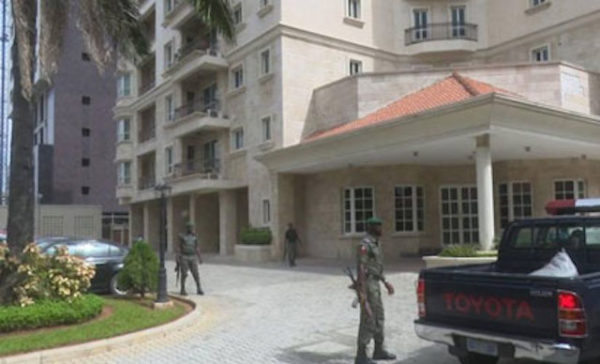
The house where the monies were discovered
The commission said the discovery followed an operation triggered by a whistleblower’s alert received by its Lagos office on Wednesday morning.
The source was said to have noticed suspicious movement of bags in and out of a particular apartment in the building. According to the source, the movers of the bags made it look like they were bringing in clothes.
The commission quoted another source, who is conversant with the apartment, as saying that a woman usually appeared on different occasions with ‘Ghana Must Go’ bags.
“She comes looking haggard, with dirty clothes but her skin didn’t quite match her outward appearance, perhaps a disguise”, EFCC quoted the source as saying.
“On getting to the building, operatives met the entrance door locked. The guards at the gate told the operatives that nobody resides in the apartment, but some persons come in and out once in a while. In compliance with the magisterial order contained in the search warrant, the EFCC used minimum force to gain entrance into the apartment,” it said.
According to the commission, monies were found in two of the four bedrooms in the apartment.
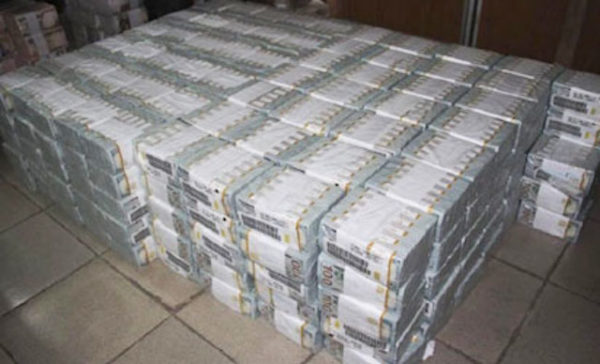
Further search by operatives into the wardrobe in one of the rooms revealed that it was warehousing three fire proof cabinets hidden behind its wooden panels.
An assessment of the content of the cabinets revealed neatly arranged US Dollars, Pound Sterlings and some Naira notes in sealed wrappers. Preliminary findings, the EFCC said, indicated that the funds were proceeds of unlawful activity.
The commission said investigation into the discovery has started.
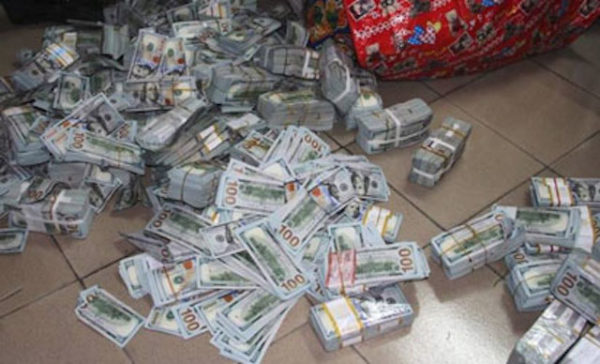
Photo Credit: Facebook – EFCC
Subscribe to:
Posts
(
Atom
)


